There is a dirty secret in the generative music space that prompt engineers rarely speak of and algorithmic demo reels carefully omit: raw AI music outputs sound deceptively convincing on cheap laptop speakers, and completely fall apart on real audio systems.
Take a brand-new generation from any premier foundation model: whether it was generated through autoregressive token prediction like YuE 2, or through latent diffusion networks. On the surface, the composition sounds astonishing. The arrangement is dense, the counter-melodies intertwine, and the vocal timbre sounds strikingly human.
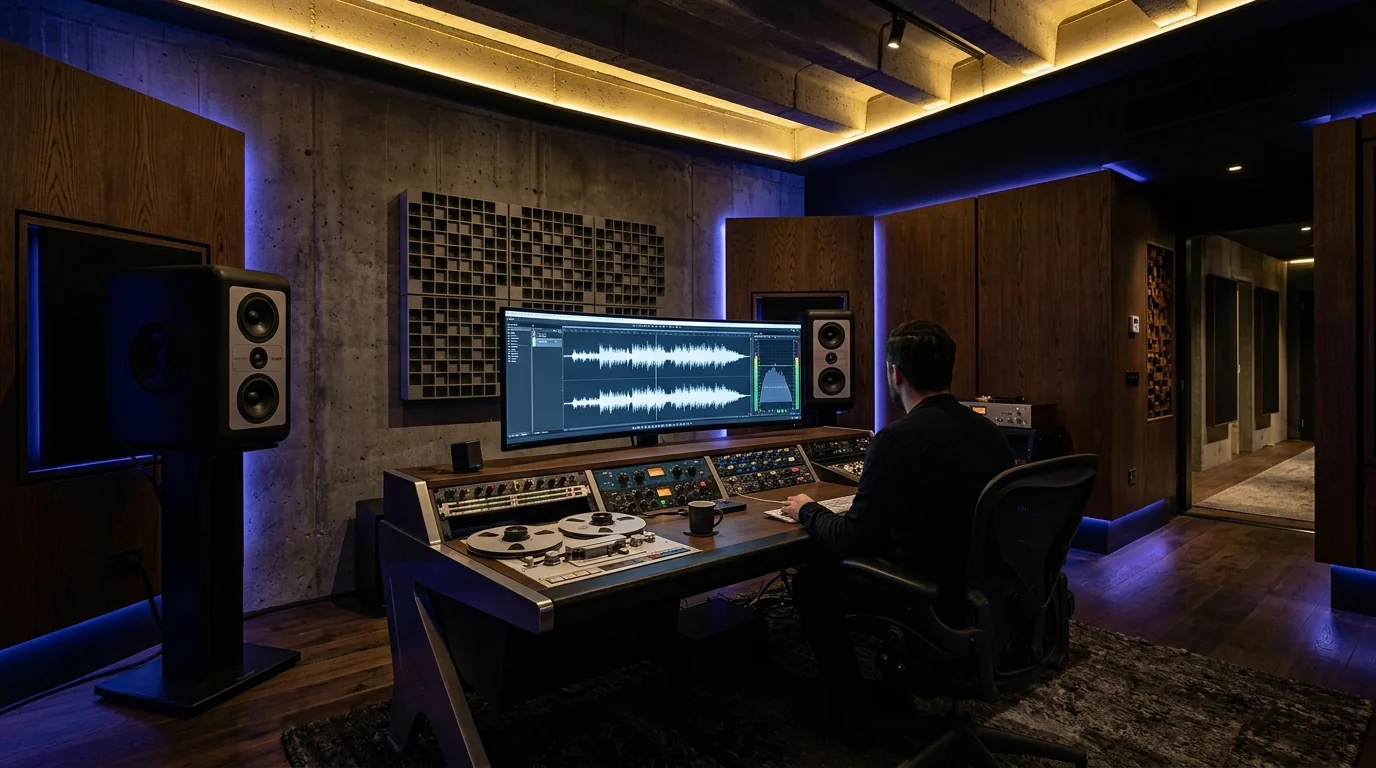
Then, plug that raw audio into a pair of calibrated studio reference monitors. Or play it through a high-end club sound system. Or collapse the audio to mono on a smartphone held in your hand.
Suddenly, the kick drum completely vanishes into thin air. The low end turns into a muddy, suffocating drone that vibrates speaker cones without producing audible pitch. The vocals bite your eardrums with an icy, metallic 7 kHz screech. And the moment the track is uploaded to Spotify or YouTube, the streaming transcoder turns it into a crunchy, distorted mess of inter-sample clipping.
The music didn't fail. The physics of neural sound generation did.
§01 The illusion of the "AI-Mastered" checkbox
When artists encounter these acoustic anomalies, their first instinct is to turn to automated commercial mastering platforms. We have all seen the marketing: "Instant AI Mastering for $19.99 a month." You drop your WAV file into a drag-and-drop web portal, a spinning circle animates for twenty seconds, and a downloadable file appears labeled "Mastered."
What actually happened under the hood?
In ninety-nine percent of commercial "cloud mastering" services, nothing acoustic was analyzed. The engine loaded a static multiband compressor curve, applied heavy top-end shelf EQ to create the psychological illusion of "crispness," and slammed the signal into a digital brickwall limiter to push the loudness up to an ear-splitting -8 LUFS.
Traditional mastering software was built under a fundamental assumption: that the incoming recording was captured by physical microphones obeying the laws of acoustics, routed through real preamps, and mixed by a human engineer who placed instruments across a physical stereo field.
Generative audio models do not obey acoustic physics. They obey probabilistic token weights and latent vector math. When a neural decoder reconstructs audio from compressed acoustic latent tokens, it introduces specific, predictable digital pathologies that human-engineered tracks never produce. Treating AI music with tools designed for 1990s rock recordings is an exercise in futility.
§02 Pathology #1: The 28Hz Infrasonic Energy Drain
The first invisible flaw living in generative audio files occurs in the deepest basement of the frequency spectrum: the sub-audible infrasonic zone below 30 Hz.
When neural latent decoders (such as EnCodec, SoundStream, or DAC vocoders) dequantize acoustic frames back into discrete time-domain waveforms, they frequently generate a continuous, undulating direct-current (DC) offset and sub-audible low-frequency rumble between 5 Hz and 28 Hz.
Human ears cannot hear 18 Hz. But audio amplifiers and digital-to-analog converters feel every single millivolt of it. This invisible infrasonic energy consumes massive amounts of digital dynamic headroom. Because traditional limiters react to absolute peak amplitude regardless of frequency, this silent 15 Hz wobble triggers the limiter's compressor threshold long before the actual musical kick drum hits.
The result? The entire mix pumps and gasps uncontrollably, suffocated by an energy ghost that nobody can even hear.
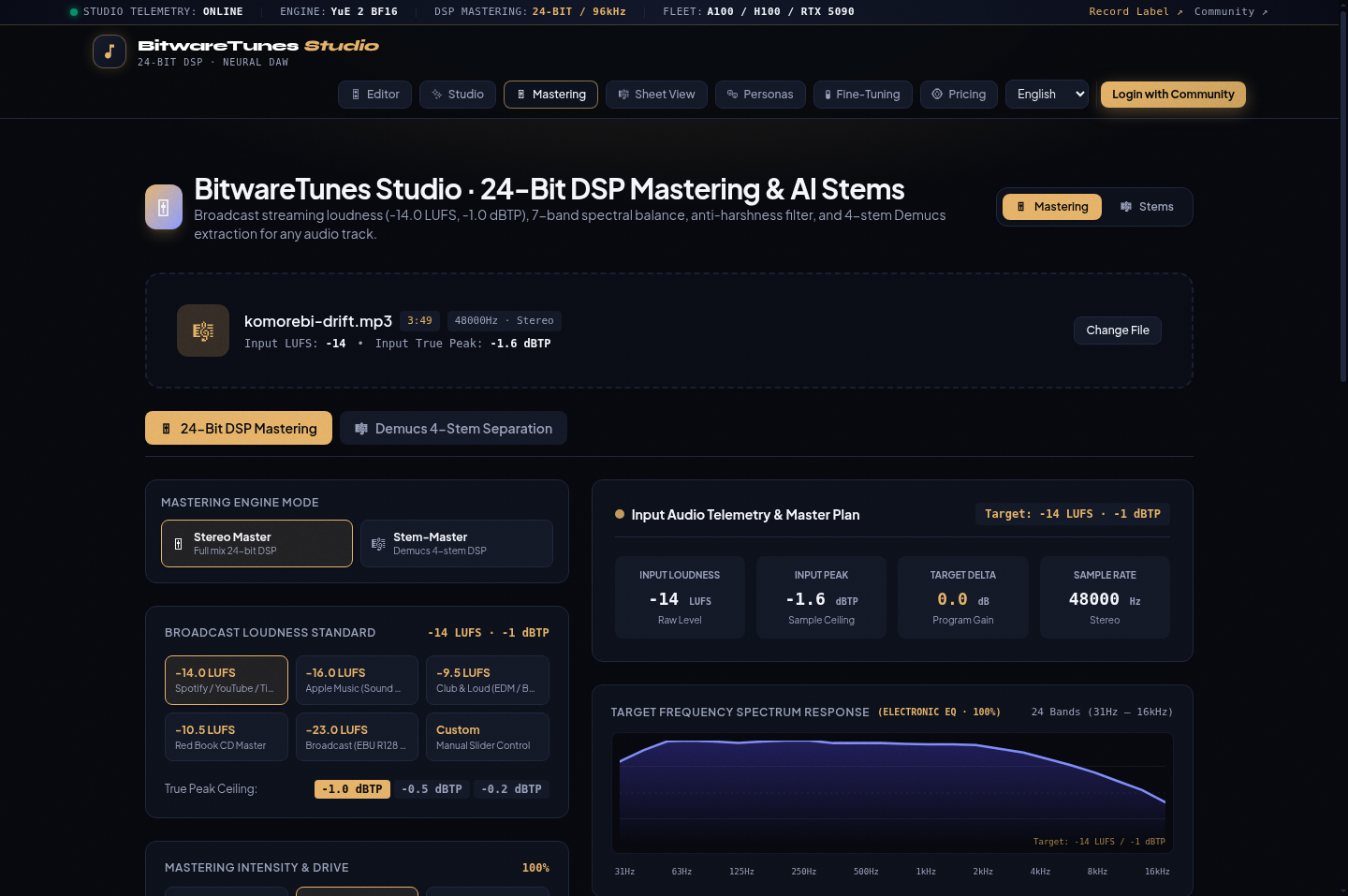
Our mastering pipeline initiates with a 4th-order zero-phase Butterworth high-pass filter anchored strictly at 28 Hz. By processing the audio forward and backward across the buffer (sosfiltfilt), we eliminate infrasonic DC drift and sub-30Hz sludge with zero group delay and 0° of phase distortion, instantly reclaiming up to +2.8 dB of clean dynamic headroom for the musical bassline.
§03 Pathology #2: Sub-Bass Phase Incoherence
If infrasonic drift is a thief of headroom, sub-bass stereo incoherence is a killer of records. This is by far the most dangerous flaw in modern AI music generation.
In physical acoustic recordings, low bass frequencies (below 100 Hz) are naturally omnidirectional. In professional recording studios, engineers almost universally record bass guitars, kick drums, and 808 sub-bass in strict center mono. Why? Because out-of-phase low frequencies cause destructive interference: when the left and right speakers push and pull in opposite directions, the soundwaves cancel each other out in the physical room.
Generative neural networks have no concept of physical speaker cones. During training, stereophonic diffusion models learn to predict the left channel and the right channel as parallel numerical sequences. In the mid and high frequencies, this produces wide, pleasant stereo separation. But in the low end, the machine frequently synthesizes sub-bass waveforms that are 90° to 180° out of phase between the two channels.
An artist will walk into a venue thinking their track has massive low-end weight, only to discover that the club's mono subwoofer arrays completely cancel out the bassline, leaving only a feeble clicking hi-hat.
In Bitware Studio, Stage 2 of our mastering engine executes an Elliptical Mid-Side Sub-Bass Sum. The audio signal is instantaneously split into Mid (sum) and Side (difference) domains using linear matrix mathematics. A steep high-pass crossover filter is applied strictly to the Side channel at 110 Hz. Every microscopic fraction of stereo information below 110 Hz is collapsed into pure, focused center mono, while leaving the stereo width above 110 Hz completely untouched.
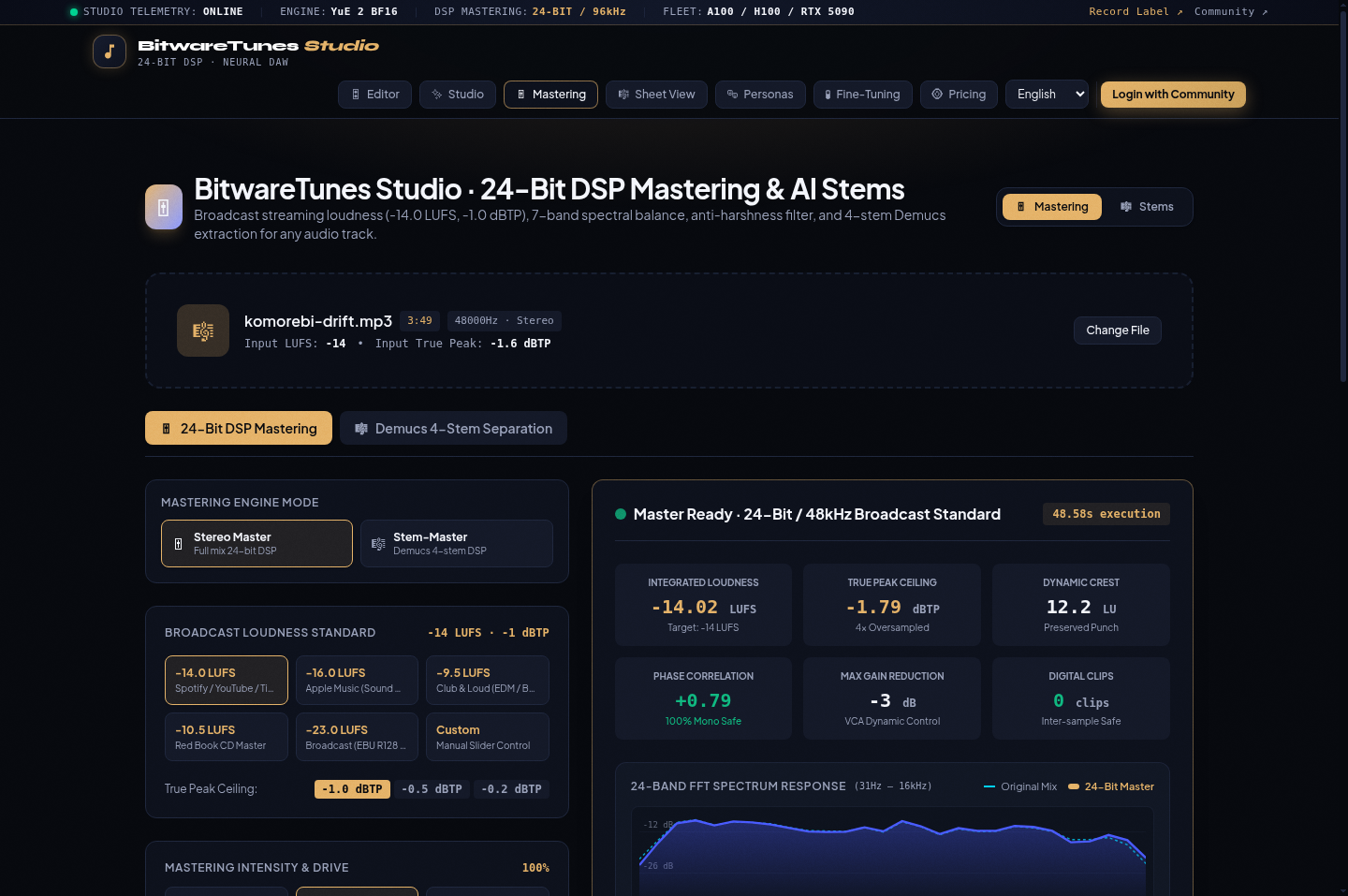
Phase correlation immediately locks into the safe zone (+0.75 to +0.95), ensuring that whether your track is played on an iPhone 16 speaker or a 50,000-watt festival rig, the bass strikes with unrelenting, physical punch.
§04 Pathology #3: The 7 kHz "Diffusion Glaze" & Sibilance Crunch
If you have listened to generative vocals for more than five minutes, you know the sound: an unpleasant, brittle, metallic harshness residing in the upper midrange between 6.5 kHz and 8.5 kHz. In the studio, engineers refer to this as the diffusion glaze.
This artifact stems from the fundamental nature of neural vocoders and autoregressive spectrogram inversion. When models invert mel-spectrograms back into audio, high-frequency transients: specifically the fricatives of human speech like "S," "T," "Ch," and "Sh": frequently suffer from micro-discontinuities. Instead of smooth vocal breath, the algorithm produces jagged, resonant micro-spikes that fatigue human ears within thirty seconds.
How do amateur producers attempt to fix this? They drop a static equalizer notch at 7 kHz. But doing so ruins the track: the vocal loses its air, the cymbals turn dark and muffled, and the mix sounds like a heavy wool blanket was thrown over the speakers.
Our mastering architecture uses an Adaptive Dynamic Anti-Harshness Matrix. Rather than applying a blunt static EQ cut, our DSP continuously computes the spectral flux of the 6.8 kHz–8.2 kHz band against the overall RMS level. When a sharp, synthetic sibilant spike erupts, an ultra-fast dynamic notch attenuates the problem frequency by 3 to 6 dB within 1.2 milliseconds, and instantly releases the moment the transient passes.
The harshness is surgically excised without stealing an ounce of brightness or vocal presence from the performance.
§05 Pathology #4: Digital Sterility & The Need for Harmonic Glue
There is a paradox at the heart of AI audio: despite its internal glitches, generative music is mathematically sterile. It is rendered inside 32-bit floating-point CPU registers. It has never interacted with the physical world: no copper cables, no transformer iron cores, no magnetic tape particles, and no vacuum tube grid voltages.
In analog recording studios, classic records achieve their cohesive "glue" because the audio passes through physical transformers and analog tape machines. These physical components generate subtle even and odd harmonic overtones: musical frequencies at 2x and 3x the fundamental that bond disparate instruments into a unified, warm sonic tapestry.
In Stage 5 and 6 of the Bitware Studio engine, we introduce physical analog modeling back into the mathematical chain:
- Symmetrical & Asymmetrical Harmonic Saturation: A modeled vacuum tube triode stage introduces warm 2nd-order even harmonics that thicken vocal bodies and acoustic instruments, paired with subtle 3rd-order odd harmonics that give electric guitars and synthesizers analog bite.
- High-Frequency Spatial Air Widening: A precision Mid-Side spatial processor elevates the extreme high frequencies (above 10.5 kHz) strictly in the Side channel, opening up a three-dimensional, holographic soundstage that prevents the mix from sounding boxed into the center.
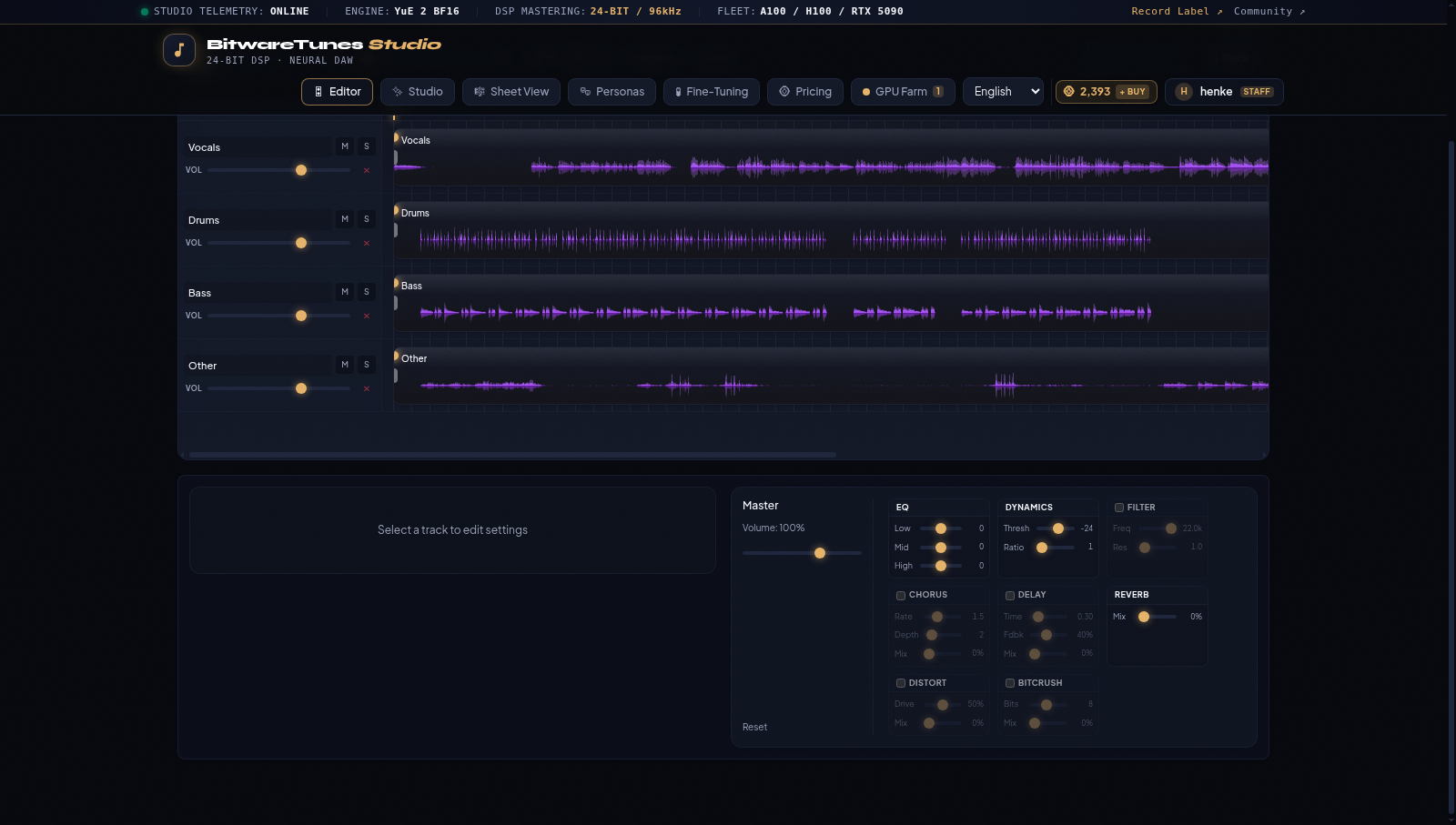
- Demucs 4-Stem Surgical Mastering: For tracks with severe mix imbalances, Bitware Studio allows artists to toggle into Stem-Master Mode. In this mode, the session automatically runs through Demucs AI stem separation, isolating Vocals, Drums, Bass, and Other onto individual tracks in the Neural DAW (shown in Fig 3.0), allowing discrete dynamic control before the final stereo summing bus.
§06 Pathology #5: The Streaming Inter-Sample Peak Trap
Even if an artist manages to balance their EQ and glue their mix, a final trap awaits them at the distribution gate: the True-Peak inter-sample reconstruction overshoot.
When you master a song to 0.0 dBFS or -0.1 dBFS using a standard peak limiter, every digital sample stays within the numerical boundary. However, streaming platforms (Spotify, Apple Music, YouTube Music, Tidal) do not play raw PCM audio to consumer devices. They transcode your file into lossy formats: Ogg Vorbis, AAC, or Opus.
When a consumer's DAC (digital-to-analog converter) reconstructs that compressed audio into continuous electrical voltages, the smoothing filter interpolates between adjacent digital samples. If those samples were slammed close to the ceiling, the reconstructed analog waveform will overshoot the digital boundary by up to +2.5 dBTP (True Peak).
This results in brutal, harsh clipping distortion on car stereos, AirPods, and smart speakers. Furthermore, streaming loudness normalization algorithms penalize overshoots by turning down the overall volume of your track, making your master sound quieter and weaker than commercial label releases.
Our Stage 8 Brickwall Limiter runs with 4x internal oversampling and 1.5ms lookahead. By calculating the inter-sample trajectory at four times the target sampling rate (192 kHz internal), our DSP detects and catches every single reconstruction peak before it happens. With strict compliance targeting -1.0 dBTP (broadcast standard) and -14.0 LUFS integrated loudness, your music plays back loud, punchy, and completely pristine across every streaming platform on earth—with zero DAC clipping.
§07 Standalone Access & Community Privileges at master.bitwaretunes.com
Now comes the question that skeptics always ask when discovering BitwareTunes: "Why are you making this available, and how does access work?"
In the legacy music industry, mastering was kept behind an intimidating wall of mystique. Commercial studios charged hundreds of dollars per track. In the contemporary AI music ecosystem, corporate software companies have replaced human gatekeepers with paywalls, locking high-resolution 24-bit WAV downloads behind recurring monthly subscriptions and charging extra for stem separation.
BitwareTunes operates on an opposite philosophy: sovereign independent artistry with transparent, democratized tools. To support music producers worldwide, we have launched the complete mastering suite as an independent standalone destination at master.bitwaretunes.com, backed by our distributed multi-node processing cluster (Node 1–4):
- 💳 Separate Paid Accounts for External Producers ($10 for 250 Credits): External creators, studios, and audio engineers do not need to be community members. You can register an independent standalone account directly at master.bitwaretunes.com and purchase 250 mastering credits for $10.00 USD via Stripe—just $0.04 per broadcast master. No recurring subscription lock-in, no monthly expiration, completely separate from the community.
- 🔒 Bitware Community is Strictly Invite-Only (1,000 Free Credits): The Bitware creative community at community.bitwaretunes.com is a private, invite-only collective for verified artists and collaborators. All invited community members master 100% free with an automatic allocation of 1,000 free mastering credits via Discourse Connect SSO.
- 🚀 Distributed Cluster Queue: When 100 producers submit masters simultaneously, jobs are load-balanced across our 4 dedicated processing nodes (Node 1–4), preventing server bottlenecks.
Every artist using Bitware Studio and master.bitwaretunes.com gets full access to our complete mastering engine:
- Full 8-Stage 24-Bit DSP Processing: 28Hz Infrasonic Scythe, 110Hz Elliptical Sub-Bass Mono Sum, 7kHz Anti-Harshness Dynamic De-Esser, Analog Saturation, Spatial Air Widener, and 4x Oversampled True-Peak Limiter.
- Demucs AI 4-Stem Separation: Instant multitrack isolation of Vocals, Drums, Bass, and Other.
- Real-Time Level-Matched A/B Auditioning: Listen to your master compared to your raw mix at exactly equal perceived volume, ensuring you are evaluating acoustic clarity rather than being tricked by loudness bias.
- Unrestricted Multi-Format Export: Download pristine 24-Bit / 48kHz Broadcast WAV, 16-Bit / 44.1kHz Red Book Dithered WAV, 24-Bit Lossless FLAC, and 320 kbps MP3 with zero watermarks.
The future of music belongs to creators who master their craft. We provide the tools. You provide the vision.